“Time is running out, water is running out,” UN Secretary-General Ban Ki-moon told the international business CEOs and civil society leaders in Davos, Switzerland, adding that the world needed to adapt to this reality.
Underscoring that water scarcity poses a grave threat to economic growth, human rights and national security, the United Nations.
Can we have an impact?
IEEE created “Water for the World” to tackle issues of water availability in developing countries. Availability means new (and plentiful) water; it means good quality water; and it means efficient reuse of water. An international panel was convened to prioritize actions and develop demonstration pilot programs. The Pilots had to be
- Realizable within one year Scalable
- Sustainable
- Reusable
- Repeatable
- Fundable
For more details read: A Blueprint for Water For the World
IEEE has identified several projects for initial consideration in the program:
- Rainwater Harvesting in India for food security
- Protecting drinking water in Ghana
- Monitoring Water Quality in Lake Nicaragua
- Improving drinking water quality in Bangladesh
Rainwater Harvesting in India
Semi-arid areas are at the mercy of rain for agriculture production. Low annual
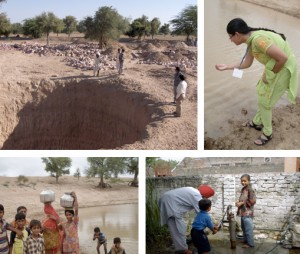 rainfall with very high co-efficient of variation results in subsistence rain fed farming. Rainfall, when accumulated, can result in a large enough volume of assured water, which in turn has a significant impact on subsistence farming. This pilot project created a means to capture and store rainwater for later use in irrigating staple food crops at the project site in village Melva of Jodhpur district of India. This will result in increased participated in planning and in building the required cistern and tank and in preparing the surfaces for harvesting rainwater. MGCS, Jodhpur and local industry have built a training facility to support long-term sustainability. The experiences will be shared with nearby villages, thereby enabling them to repeat the project.
See Water for the World Flyer .
Protecting drinking water in Ghana

Ghana has acute water security and governance problems, which translates into inefficient water services and poor maintenance. Environmental issues of water pollution due to illegal activities and increasing drought are significant and seasonal shortage of water leads, for example, to temporary closure of some schools and other facilities in the country. A particular case of high treatment cost due to pollution from human activities and urban water shortage is the Weija Dam that supplies western Accra’s population.
The main cause of the Weija Dam problem is encroachment into the catchment with informal housing, agriculture, fishing and other land-based economic activities, the eviction of which will cost estimated $3 million to effect by the government. The pilot project provides improved information to government and utility decision makers by organizing the spatial data sets for telling the real story. The output of the project will be used for a multi-party conference on how to most effectively improve water governance and water security systems associated with the Weija Dam. The Pilot project outcomes will then be extended to other regions of Ghana.
Monitoring Water Quality in Lake Nicaragua
The development and implementation of a satellite-based water quality monitoring system for a Central American lake is an important step forward in the creation of a sustainable environment for Lake Nicaragua. This activity utilizes Moderate Resolution Imaging Spectro-radiometer (MODIS) satellite sensors in combination with recently developed atmospheric and water quality algorithms to examine historic and current trends in this lake system. At the conclusion of the project, local water management staff will be trained in the use of this technology. This project will also contribute to our global understanding of satellite applications for water quality quantification. The development of a GEOSS network first requires establishment of regional nodes and this project helps establish this foundation.
Improving drinking water quality in Bangladesh
 Arsenic contamination of groundwater has been an emerging global challenge for safe drinking water management. Arsenic is a carcinogen which can cause various kinds of cancers and cardiovascular, neurological and other diseases. Approximately, 30-60 million people may be at the risk of drinking arsenic contaminated water in Bangladesh. About 46% of the installed arsenic safe water technologies were not functioning due to the problems related to its designs, and/or operation and maintenance problems.
The pilot project will develop an appropriate system for safe drinking water supply among 14,000 of the poorest rural populations in 80% arsenic contaminated Muladi sub-district. The challenges are to: (i) provide safe drinking water among selected priority 14000 people in one/first year based on development of community water technologies from surface-water, groundwater and/or rainwater sources and (ii) develop an empowered women based network for operations of the system and also for community health education about safe drinking water. Longer term, the project objective is to develop and promote a continuing drinking water development mechanism for poor communities by linking the project to an existing networking institution.


No Comments